

Debate Club
Puzzles Ams
My history with Puzzles Ams began in sixth grade, when I competed at Hanoi Debate Tournament, completely unaware that the enormous event was organized by high schoolers. I returned the following year, equally awestruck, and applied to Puzzles Ams as soon as I entered high school. Somehow, I eventually became its president!
Every Wednesday lunchtime, my homeroom, C209, became a training ground for our “little foxes,” Puzzles Ams’ younger debaters. We dissected arguments and prepared for competitions, eventually seeing our members reach the national finals. Watching their progress brought me a different kind of happiness from winning a debate myself.
Our Mock Trial program tested my creativity and precision. After years of picking apart other people's arguments, I was suddenly responsible for constructing a fictional legal case in which every word and piece of evidence had to fit together. Occasionally, even I was intimidated by my own case!

Then came Hanoi Debate Tournament, where I found myself organizing the very competition I'd admired as a middle schooler. Coordinating over 600 participants, international judges, and five months of logistics was exhausting, though I grew increasingly comfortable handling problems I once thought overwhelming. I also introduced scholarships and encouraged school-based teams, hoping the tournament could help strengthen the wider debate community.


Camp Aletheia demanded a different sort of patience. Working with younger children meant handling everything from campers sleeping through lessons to dramatic protests after losing arguments. I learned to take their frustrations seriously, even when the situations themselves were rather hilarious.
Presiding over Puzzles Ams has stretched me in ways I never anticipated. I've learned to care about other people's progress, accept responsibility for difficult decisions, and occasionally laugh at the chaos. I arrived as a little girl impressed by everything Puzzles Ams could accomplish. These days, I'm happiest watching our little foxes discover that they can accomplish just as much.


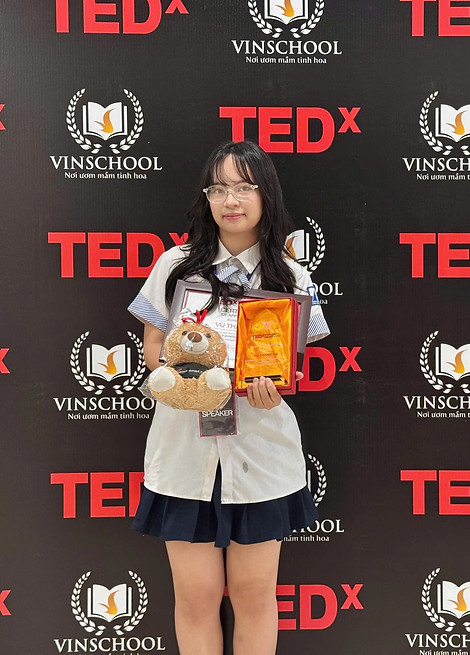
TEDx Speaker
TedX VinSchool Smart City
I gave my TEDx talk the rather suspicious title “The Key to Good Habits: Almost Nothing.” It sounds like an excellent excuse to be lazy, I know! My argument, however, was that motivation is notoriously unreliable, and ambitious plans often fall apart before they become routines. I wanted to explore how tiny, repeatable actions could make consistency feel less intimidating.
Preparing for TEDx also introduced me to the finer details of public speaking. I practiced the M-method for eye contact and learned to move naturally across the stage to complement my words. I used to focus almost entirely on delivering a good speech; this time, I became much more conscious of how I connected with the audience. It was quite a lot of preparation for a talk about doing almost nothing!
My Debate Journey
The first time I went to debate, I was awestruck that everyone seemed to speak faster and know far more about the world than I did. I remember being completely overwhelmed, yet I left wanting to do it all over again.
Over the years, debate became one of my favorite ways to spend an afternoon (and, quite often, an entire weekend). I loved the frantic preparation before each round and the strange thrill of defending a position I personally disagreed with. There was always something new to read or a clever rebuttal that made me question an argument I’d spent hours preparing.
I also loved the people. Some of my closest friendships began with fierce disagreements over motions and grew through conversations at tea break. Eventually, I wanted to take that curiosity elsewhere, particularly into economics and healthcare, where competing perspectives rarely fit neatly into a debate round. I still catch myself building arguments during everyday conversations, which is probably not my most endearing habit.
Some of my achievements:


